Greenhouse gas emissions
In recent years, the global greenhouse effect has led to ozone layer depletion and extreme weather events. I-Chiun Precision has actively aligned itself with global issues and responded to government policies, beginning in 2021 to conduct a comprehensive inventory of greenhouse gases emitted from its plant area. This annual inventory categorizes greenhouse gases by their source into direct and indirect emissions. Direct emissions are generated from refrigerants used in plant utilities, carbon dioxide fire extinguishers, vehicle fuel consumption, and wastewater treatment. Indirect greenhouse gas emissions originate from purchased electricity, all sourced from Taiwan Power Company.
| Greenhouse gas emissions (CO2e metric tons) |
2023 year |
2024 year |
2025 year |
Category 1:
Wastewater generated from the use of refrigerant in factory public equipment, carbon dioxide fire extinguishers, vehicle fuel, and wastewater treatment. |
166.3408 |
120.5464 |
201.7967 |
Category 2:
All purchased electricity was acquired from Taiwan Power Company. |
12,807.3946 |
14,779.9551 |
13,026.1516 |
Category 3:
Emissions from upstream transportation and cargo distribution, emissions from employee commuting, emissions from customer and visitor transportation, emissions from business travel, and emissions from waste transportation. |
275.5785 |
251.8243 |
264.9899 |
Category 4:
Emissions originating from the purchase of goods, capital goods, and solid and liquid waste disposal. |
24,562.9992 |
22,159.9761 |
34,844.6365 |
| Total greenhouse gas emissions (CO2e metric tons) |
37,812.3131 |
37,312.3019 |
48,337.575 |
| Sales revenue (millions) |
2,598.48 |
2,593.93 |
3,144.89 |
| carbon emission intensity |
14.5517 |
14.3845 |
15.3702 |
Note: The declarations for 2023 and 2024 were corrected on January 8, 2026, in accordance with the declaration.
Note: Carbon emission intensity = Total greenhouse gas emissions (CO2e metric tons) / Sales revenue (millions).
TCFD Climate-Related Financial Disclosures
(I) Climate-related financial disclosures and structures
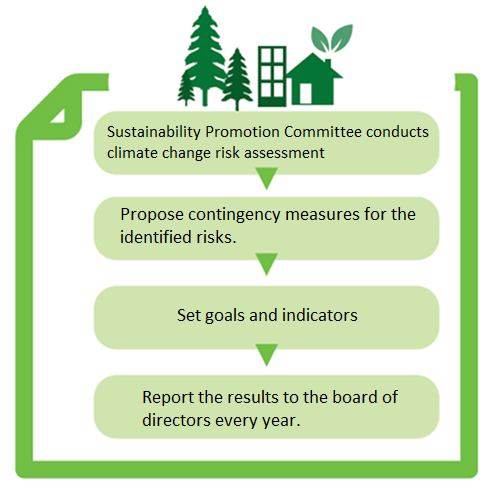
With reference to the Proposal on Climate-related Financial Disclosure published by TCFD, the sustainability report reveals climate change information and the risks and opportunities it brings, and the sustainability implementation committee conducts climate risk analysis and control, and formulates countermeasures for climate-related risks. In addition to causing extreme weather, it also directly or indirectly affects the operation of enterprises and the consumption behavior of consumers. In order to implement a friendly environment, carry out energy-saving and carbon-reduction related management and improve the competitiveness on sustainable issues.
Climate Change Management Framework

Governance |
In order to practice corporate social responsibility, our company is led by the Sustainability Promotion Committee, which is responsible for coordinating issues related to corporate governance, environmental protection, climate change, and labor. Regular meetings on environmental, social, and governance are held, and the Chairman reports on the performance of the management system and necessary improvement suggestions to the senior management. The first quarter of each year will report the results of the previous year's implementation and the work plan for the current year to the board of directors, and listen to the opinions of the board of directors to make revisions. Incorporate climate change risk related issues and their management objectives. |

Strategy |
This paper defines short-term and medium-to-long-term timeframes for climate-related risks and opportunities, setting "1-3 years" as short-term and "4-10 years" as medium-to-long-term, and conducts climate risk and opportunity assessments accordingly. Climate risks are categorized into two main types: transitional risks and practical risks, which are further subdivided into policy and regulatory, technological, and market risks, as well as short-term and long-term risks. Opportunities are represented by water resource efficiency. |

Risk Management |
- Identify the risks to the company's operations and entities that may be caused by climate change factors (6 items in total) and potential opportunities (1 item in total).
- Based on the risk factors provided by each unit, a discussion was held, and then high risks and opportunities were selected. Short-, medium- and long-term key climate risk indicators were linked, and financial impact assessments were conducted through quantitative or qualitative methods. Then, relevant response strategies were formulated and key climate targets were set.
|

Indicators and Targets |
- When production capacity expands and raw material consumption increases accordingly, control the amount of waste generated, energy and water consumed, so that both increase non-linearly and synchronously, to achieve the goal of simultaneous increase in production capacity, revenue and environmental protection effectiveness.
- Continuously improve the selection of raw materials, and gradually replace high-pollution raw materials with environmentally friendly raw materials to reduce environmental pollution and lower prevention and control costs.
- Based on the results of the greenhouse gas and carbon footprint survey, examine high emission sources, propose improvement and reduction plans, and implement them accordingly.
|
(II) Climate change risk identification
Climate-related risks and their potential consequences are diverse, dynamic, and long-term, characterized by a high degree of uncertainty and making them difficult to quantify and rank. Therefore, in order to understand the scale of the risks it faces, I-Chiun Precision convened a meeting with the chairman and executives of the Sustainability Promotion Committee to integrate climate change risks. To develop effective management strategies to achieve the goals of risk avoidance, mitigation, or transfer. Continuously track the effectiveness of strategies and the rate of goal achievement through rolling management.
| Type |
Issues |
Climate related risks |
Potential financial risks |
Risk countermeasures |
| Transformation risks |
Policies and regulations |
1. Levy carbon fees and taxes |
1. Increased operating costs (such as compliance costs and increased premiums) |
1.Given the ongoing expansion of production lines and company scale, priority will be given to energy-saving, low-carbon, and high-efficiency models for new purchases and replacements. |
| 2. Add relevant regulations |
2. Increased costs due to fines and judgments |
2. At least once a month, conduct regulatory identification, evaluate relevant regulations related to our company after identification, and plan response strategies to reduce risks. |
| Market |
Fluctuations in raw material supply |
Production was interrupted and delivery was delayed. |
Raw material inventory is adjusted on a rolling basis, and the supplier's carbon reduction, waste reduction, energy saving performance, and climate change response capabilities are included in the evaluation. |
| Entity Risk |
short term |
The frequency of extreme weather events such as typhoons and floods is increasing. |
It affects production activities. |
1.In response to production disruptions caused by typhoons and heavy rains, we flexibly adjust production capacity and inventory. |
| 2. Regularly inspect factory buildings and equipment, and increase the frequency of maintenance and upkeep. |
| long term |
1. The probability of extreme weather increases. |
1. Increased asset insurance premiums raise operating costs. |
1. High-power-consuming and energy-intensive equipment will be prioritized for replacement, particularly devices such as air conditioners, cooling systems, and heating systems. |
| 2. Rising average temperatures reduce the heat dissipation capacity of machinery and equipment, increasing the likelihood of equipment damage. |
2. Increased consumption of water and electricity usage |
2. Except for special units requiring temperature and humidity control, the air conditioning temperature in offices, general affairs areas, public spaces, and meeting rooms should be set at 25 degrees Celsius or higher. |
| Opportunity |
Resource Efficiency |
1. Water Recovery and Reuse |
1. Reduce operating costs |
Wastewater can be recycled and reused in the production process using recycling equipment, allowing up to 80% of the wastewater to be reused. |
| 2. Reduce water consumption and usage. |
2. Increase production capacity and boost income. |
Climate-related information for listed companies
1-Implementation Status of Climate-Related Information
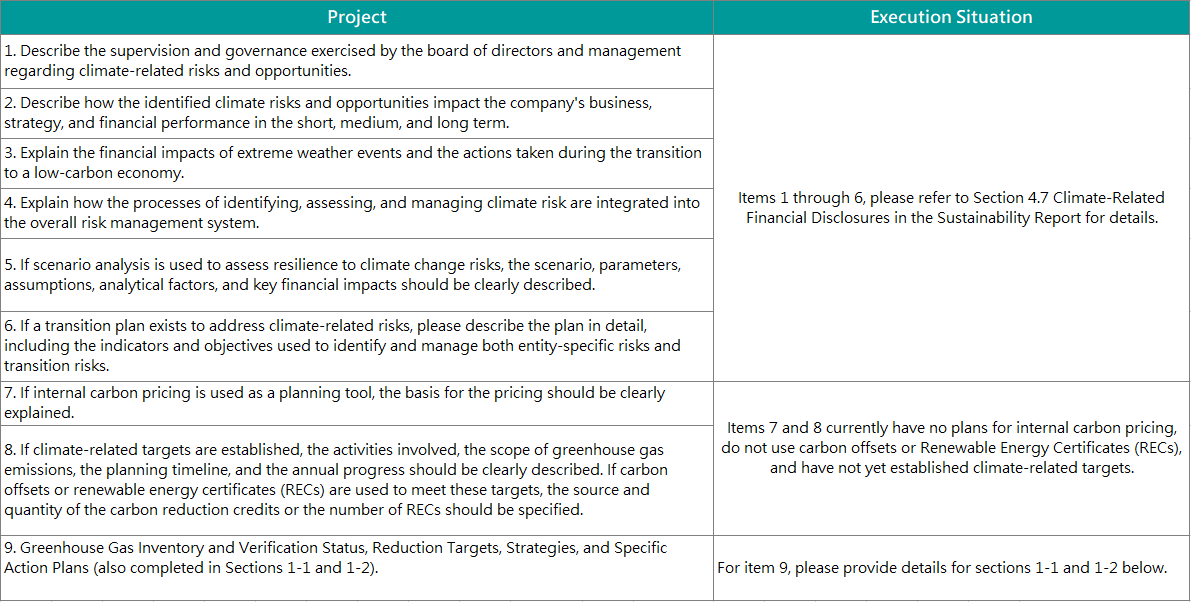
1-1 Recent Two-Year Company Greenhouse Gas Inventory and Verification Status
1-1-1 Greenhouse Gas Inventory Information
Please specify the greenhouse gas emissions for the most recent two years (in metric tons of CO2 equivalent), the intensity (metric tons of CO2 equivalent per million dollars), and the scope of data coverage.
| Greenhouse gas emissions (CO2e metric tons) |
2023 year |
2024 year |
2025 year |
Category 1:
Wastewater generated from the use of refrigerant in factory public equipment, carbon dioxide fire extinguishers, vehicle fuel, and wastewater treatment. |
166.3408 |
120.5464 |
201.7967 |
Category 2:
All purchased electricity was acquired from Taiwan Power Company. |
12,807.3946 |
14,779.9551 |
13,026.1516 |
Category 3:
Emissions from upstream transportation and cargo distribution, emissions from employee commuting, emissions from customer and visitor transportation, emissions from business travel, and emissions from waste transportation. |
275.5785 |
251.8243 |
264.9899 |
Category 4:
Emissions originating from the purchase of goods, capital goods, and solid and liquid waste disposal. |
24,562.9992 |
22,159.9761 |
34,844.6365 |
| Total greenhouse gas emissions (CO2e metric tons) |
37,812.3131 |
37,312.3019 |
48,337.575 |
| Sales revenue (millions) |
2,598.48 |
2,593.93 |
3,144.89 |
| carbon emission intensity |
14.5517 |
14.3845 |
15.3702 |
Note 1: Direct emissions (Scope 1) refer to emissions directly from sources owned or controlled by the company. Energy indirect emissions (Scope 2) are indirect greenhouse gas emissions resulting from the consumption of purchased electricity, heat, or steam. Other indirect emissions (Scope 3) are emissions generated from company activities that are not energy indirect emissions but come from sources owned or controlled by other companies.
Note 2: The scope of data for direct emissions and energy-related indirect emissions shall be managed in accordance with the schedule specified in Article 4-1, Paragraph 2 of the Taiwan Stock Exchange's "Operational Procedures for the Preparation and Submission of Sustainability Reports by Listed Companies" (hereinafter referred to as the Operational Procedures). Information on other indirect emissions may be disclosed voluntarily.
Note 3: Greenhouse Gas Inventory Standards include the Greenhouse Gas Protocol (GHG Protocol) and ISO 14064-1, issued by the International Organization for Standardization (ISO).
Note 4: The intensity of greenhouse gas emissions can be calculated per unit of product or service, or based on turnover. However, at a minimum, the data calculated using turnover (in NT$ million) should be reported.
1-1-2 Confirmed Information on Greenhouse Gases
An explanation of the assurance situation for the most recent two years, including the scope of assurance, the assurance organization, assurance standards, and assurance opinions.
| |
2023 year |
2024 year |
2025 year |
| Confidence Interval |
● No. 17 & 19, Wugong 5th Road, Xinzhuang District, New Taipei City (Our Factory) |
● No. 17 & 19, Wugong 5th Road, Xinzhuang District, New Taipei City (Our Factory) |
● No. 17 & 19, Wugong 5th Road, Xinzhuang District, New Taipei City (Our Factory) |
| ● No. 3, Wuquan 2nd Rd., Xinzhuang Dist., New Taipei City (Factory 3)。 |
● No. 3, Wuquan 2nd Rd., Xinzhuang Dist., New Taipei City (Factory 3)。 |
● No. 3, Wuquan 2nd Rd., Xinzhuang Dist., New Taipei City (Factory 3)。 |
| ● No. 49, Wugong 6th Rd., Wugu Dist., New Taipei City (Factory 4) |
● No. 49, Wugong 6th Rd., Wugu Dist., New Taipei City (Factory 4) |
● No. 28~32, Xinzhi 8th Rd., Xinzhuang Dist., New Taipei City ((Diamond Plant) ) |
| |
|
● No. 152, Sec. 2, Guangfu Rd., Sanchong Dist., New Taipei City |
| Confirmation Agency |
● SGS Taiwan Ltd. |
● ARES International Certification Co., Ltd. |
● ARES International Certification Co., Ltd. |
| ● ARES International Certification Co., Ltd. |
| Confirmation criteria |
ISO 14064-3:2006 |
ISO 14064-3:2006 |
ISO 14064-3:2006 |
| Confirmation of opinion |
● The government-led " large leading small" project, aligned with the client's schedule, was verified between May and July 2025. |
● The 2024 data verification was conducted in November 2025. Therefore, the existing ISO 14064 data is derived from recalculated and updated figures based on the original framework. |
● The 2025 data validation was conducted in April 2026. |
Note 1: It should be handled according to the schedule specified in Article 4-1, Paragraph 3 of these operating procedures.
Note 2: Assurance providers must comply with the relevant regulations for sustainability report assurance established by the Taiwan Stock Exchange Corporation and the Taipei Exchange.
Note 3: For disclosure details, please refer to the best practice reference examples available on the Corporate Governance Center website of the Taiwan Stock Exchange.
1-2 Greenhouse Gas Reduction Targets, Strategies, and Specific Action Plans
1. Baseline year for greenhouse gas reduction: 2025.
2. Base Year Data: Please refer to the total emissions data for the year 2025 in the table above, measured in metric tons of CO2e per year.
3. Reduction Target: In accordance with the schedule of the Sustainable Development Roadmap for TWSE/TPEX-Listed Companies, the Company will complete the greenhouse gas (GHG) inventory for individual companies following the GHG Protocol in FY2027. Therefore, the base year for GHG emissions reduction will be updated to 2026.
4.Its Data, reduction targets, strategies, specific action plans, and target achievement status: None
5. Strategies and specific action plans: Please refer to Section 4.7 Climate-related financial disclosures in this report.
6. Status of achievement of reduction targets: Please refer to Section 4.7 Climate-related financial disclosures in this report.
Note 1: It shall be handled in accordance with the time schedule specified in Item 4 of Article 4-1 of these Measures.
Note 2: The base year should be the year in which the consolidated financial statement audit was completed at the boundary of the consolidated financial statements. For example, according to Article 4-1, Paragraph 2 of these Operating Procedures, companies with capital of NT$10 billion or more should complete the audit of their consolidated financial statements for the year 2024 in 2025. Therefore, the base year is 2024. If a company has completed the audit of its consolidated financial statements earlier, the earlier year can be used as the base year. The data for the base year can be calculated from the average of a single year or several years.
Note 3: For disclosure details, please refer to the best practice reference examples available on the Corporate Governance Center website of the Taiwan Stock Exchange.